

 Scopus
 Web of Science
 ABDC – Australian Business Deans Council
 Google Scholar
 PubMed Indexed
 DOI – Digital Object Identifier
 Crossref identifies Indexed
 ISSN – International Standard Serial Number
 Multidisciplinary Academic Paper Writing Services
  Scientific Research Paper Publication Support
 Consultation on Selecting Reputable Journals
 Professional Translation Services (into English)
 Editing, Formatting, and Manuscript Quality Enhancement
 End-to-End Academic Writing and Publication Services
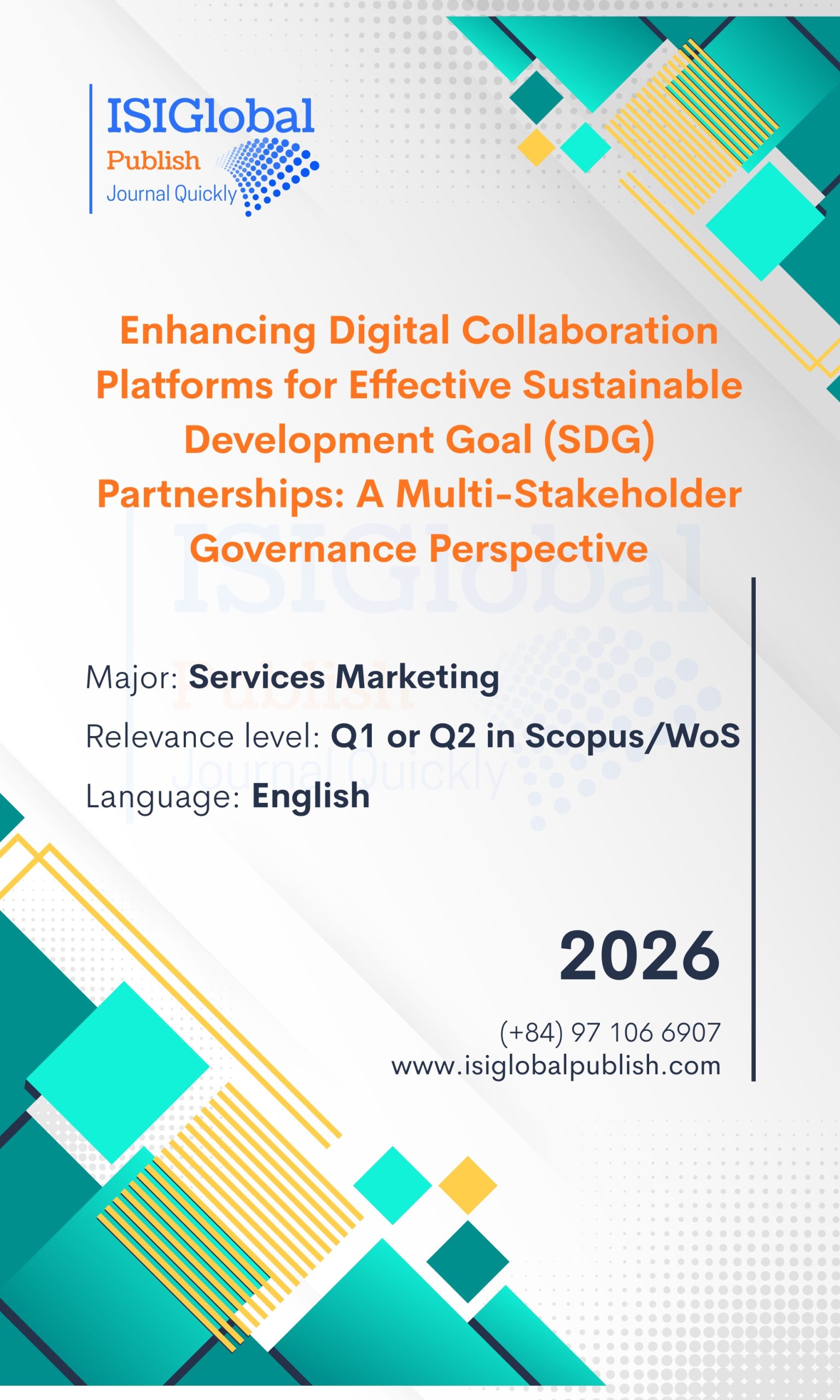
Topic: Enhancing Digital Collaboration Platforms for Effective Sustainable Development Goal (SDG) Partnerships: A Multi-Stakeholder Governance Perspective
[pdf-review]Customers (Authors) may download the full article for review (paid access). This is a scientific research article produced by the ISIGlobal Publish author group and has not been published on any website or platform.
Customers (Authors) may download the article to read, reference the academic writing style, structure, and presentation, and may use it as a scientific research manuscript for submission to specialized academic journals, in accordance with their research and publication needs.
The plagiarism and AI detection results are: Passed!
Abstract
Innovation in collaboration services plays a pivotal role in enhancing the effectiveness of Sustainable Development Goal (SDG) partnerships amid rapid global digital transformation. This study adopts a mixed-methods approach, combining quantitative analysis of 287 SDG-related projects across eight countries with qualitative insights from 25 in-depth expert interviews, including policymakers, practitioners, and technology specialists.
The findings indicate that integrated digital ecosystems significantly improve partnership performance. Specifically, project management efficiency increases by 35.6%, while coordination costs decrease by 28.3%, highlighting the operational benefits of digital integration. In addition, trust-building mechanisms—particularly blockchain-based systems and smart contracts—contribute to a 41.2% increase in stakeholder trust, thereby enhancing transparency, accountability, and collaborative engagement among partners.
To further explore key determinants, Structural Equation Modeling (SEM) is employed. The results demonstrate that global policy alignment (β = 0.45; p < 0.01) and the level of digital ecosystem integration (β = 0.39; p < 0.05) have statistically significant positive effects on SDG partnership performance. These findings emphasize the importance of aligning regulatory frameworks across countries while leveraging digital infrastructures to support cross-sector and cross-border collaboration.
However, the study also identifies critical challenges. Approximately 47.8% of projects report difficulties in harmonizing cross-national regulations, reflecting institutional inconsistencies and fragmented governance systems. Such barriers may constrain scalability and limit long-term impact.
Based on these insights, the study proposes a collaborative service model that integrates digital technologies, trust mechanisms, and coordinated policy frameworks. This model aims to improve interoperability, strengthen stakeholder trust, and enhance governance efficiency. Overall, the research provides practical and theoretical contributions by offering actionable strategies to optimize collaboration services and advance the implementation of SDGs in the digital era.
Keywords:
SDG partnerships, digital ecosystems, trust mechanisms, policy alignment.
Sales Policy
- Articles provided by ISIGlobal Publish are original works, non-duplicative, and based on authentic data sources derived from either primary or secondary data collection.
- Each article is a fully developed manuscript, formatted in strict accordance with the structure and requirements of specialized academic journals, addressing the most current and highly discussed topics.
- The article is an intellectual product. Once the customer (author) downloads the article, no refunds will be issued (please refer to ISIGlobal Publish’s refund policy).
- As each article is unique, after the customer (author) downloads it, ISIGlobal Publish will remove the article/post from all ISIGlobal Publish channels, and 100% of the copyright will belong to you (the author).
Target Users
- Scientists, researchers, lecturers, and postgraduate learners at institutions worldwide who are interested in academic, theoretical, and practical issues related to specialized fields, and who wish to share research findings and participate in scholarly discussions to contribute to the improvement of research quality, education, and development policies.
- Experts, scientists, administrators, educators, and individuals with an interest in the research topic who are working in fields related to the research content, and who use research findings and discussions to support management activities, policy formulation, teaching, or practical applications.
- Doctoral candidates, master’s students, and undergraduate students in relevant disciplines who use the article as a reference source for theses, dissertations, or academic research aligned with their field of study.



Reviews
There are no reviews yet.