

 Scopus
 Web of Science
 ABDC – Australian Business Deans Council
 Google Scholar
 PubMed Indexed
 DOI – Digital Object Identifier
 Crossref identifies Indexed
 ISSN – International Standard Serial Number
 Multidisciplinary Academic Paper Writing Services
  Scientific Research Paper Publication Support
 Consultation on Selecting Reputable Journals
 Professional Translation Services (into English)
 Editing, Formatting, and Manuscript Quality Enhancement
 End-to-End Academic Writing and Publication Services
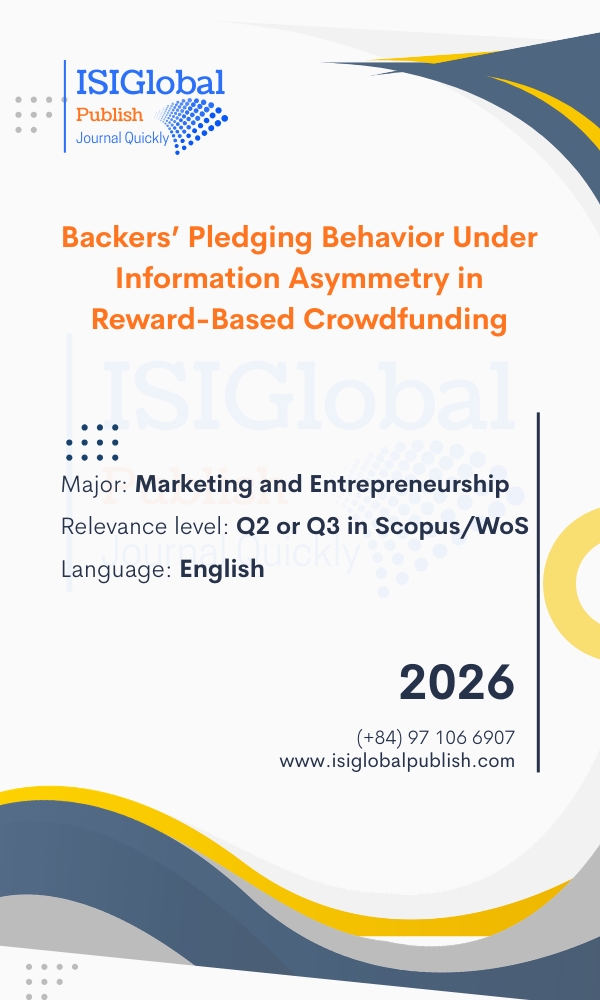
Topic: Backers’ Pledging Behavior Under Information Asymmetry in Reward-Based Crowdfunding
Customers (Authors) may download the full article for review (paid access). This is a scientific research article produced by the ISIGlobal Publish author group and has not been published on any website or platform.
Customers (Authors) may download the article to read, reference the academic writing style, structure, and presentation, and may use it as a scientific research manuscript for submission to specialized academic journals, in accordance with their research and publication needs.
The plagiarism and AI detection results are: Passed!
Abstract
This study investigates how information asymmetry shapes backers’ pledging decisions in reward-based crowdfunding environments. Drawing on signaling theory and behavioral economics, the research develops a conceptual model linking information quality, project uncertainty, trust, and social influence to funding outcomes. A mixed-methods approach is employed, combining survey data from 312 crowdfunding participants with secondary data from 428 campaigns on major platforms. Structural equation modeling (SEM) results reveal that information transparency significantly increases backers’ willingness to pledge (β = 0.41, p < 0.001), while perceived uncertainty negatively affects funding decisions (β = −0.29, p < 0.01). Trust is identified as a key mediating factor, explaining 37.5% of the variance in pledging intention. Additionally, social influence mechanisms, such as prior backer activity and community engagement, enhance perceived credibility and improve funding likelihood by 24.8%.
The findings also indicate that campaigns providing frequent updates and verifiable signals (e.g., prototypes, third-party endorsements) achieve 31.2% higher funding success rates compared to those with limited information disclosure. Importantly, the study highlights heterogeneity among backers, showing that experienced backers are less sensitive to uncertainty but more responsive to quality signals. These results contribute to the literature by offering empirical evidence on the interplay between incomplete information and decision-making in digital funding contexts.
From a practical perspective, the study provides actionable insights for project creators to optimize communication strategies and reduce information gaps. By enhancing transparency and leveraging social proof, campaign designers can improve trust formation and funding performance. The research also offers implications for platform designers to develop mechanisms that mitigate information asymmetry and support more efficient crowdfunding ecosystems.
Keywords:
Reward-based crowdfunding, information asymmetry, backer behavior, signaling theory.
Sales Policy
- Articles provided by ISIGlobal Publish are original works, non-duplicative, and based on authentic data sources derived from either primary or secondary data collection.
- Each article is a fully developed manuscript, formatted in strict accordance with the structure and requirements of specialized academic journals, addressing the most current and highly discussed topics.
- The article is an intellectual product. Once the customer (author) downloads the article, no refunds will be issued (please refer to ISIGlobal Publish’s refund policy).
- As each article is unique, after the customer (author) downloads it, ISIGlobal Publish will remove the article/post from all ISIGlobal Publish channels, and 100% of the copyright will belong to you (the author).
Target Users
- Scientists, researchers, lecturers, and postgraduate learners at institutions worldwide who are interested in academic, theoretical, and practical issues related to specialized fields, and who wish to share research findings and participate in scholarly discussions to contribute to the improvement of research quality, education, and development policies.
- Experts, scientists, administrators, educators, and individuals with an interest in the research topic who are working in fields related to the research content, and who use research findings and discussions to support management activities, policy formulation, teaching, or practical applications.
- Doctoral candidates, master’s students, and undergraduate students in relevant disciplines who use the article as a reference source for theses, dissertations, or academic research aligned with their field of study.





Reviews
There are no reviews yet.